What is Social Media Marketing? Complete Overview for Beginners & Businesses
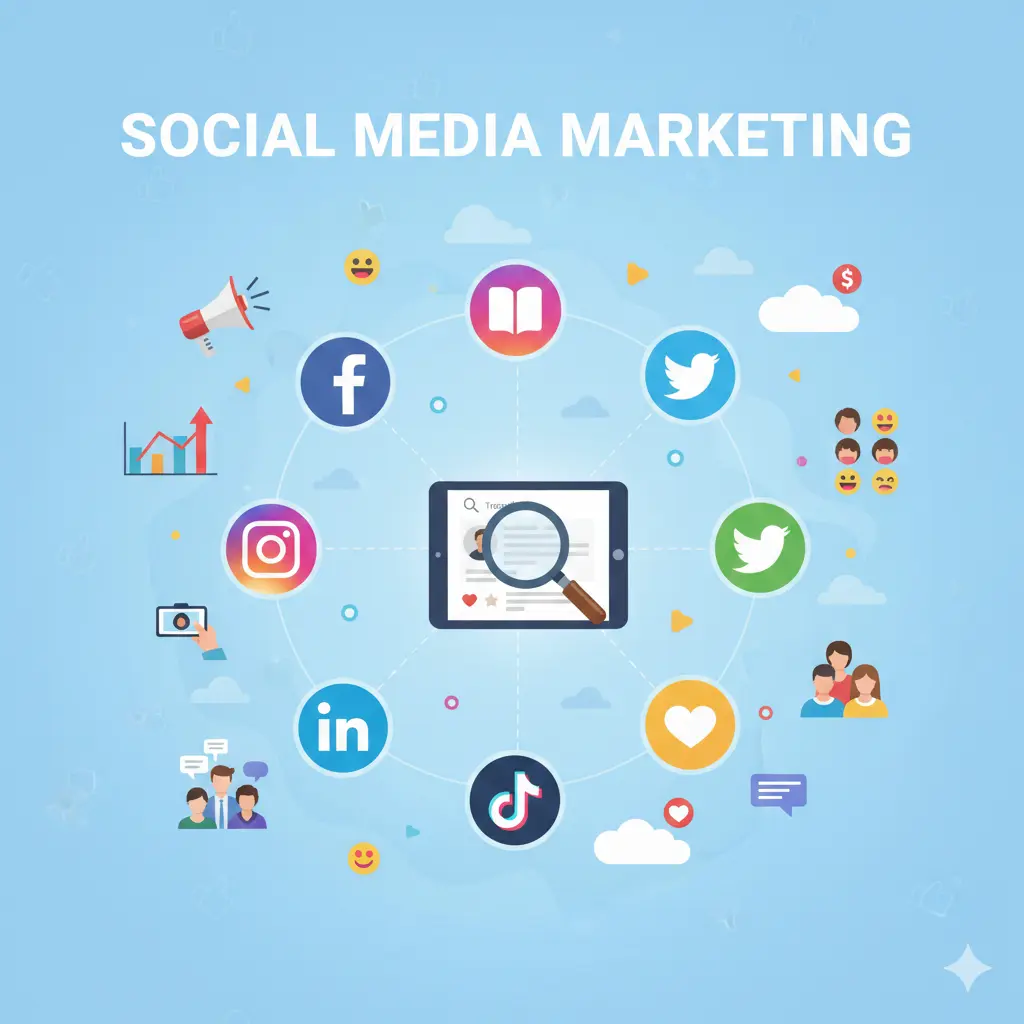
In the rapidly evolving landscape of the 21st century, the way we communicate, consume, and conduct business has shifted fundamentally. At the center of this revolution is a powerful force that has redefined the relationship between brands and consumers. This force is known as social media marketing. For any business looking to survive and thrive today, understanding the nuances of this discipline is no longer an option—it is a necessity.
Table of Contents
ToggleIntroduction to Social Media Marketing
To the average user, social media is a place to connect with friends, share life updates, or watch entertaining videos. However, for a brand like Social Crafter, these platforms represent a vast, gold-mine of data and opportunity. Social media marketing is the strategic use of these networks to build a brand, increase sales, and drive meaningful website traffic.
The power of social media lies in its ubiquity. Imagine a world where billions of people are constantly active on their handheld devices. A massive portion of the global population spends a significant part of their day scrolling through feeds, making these platforms the most influential channels for online brand promotion. Unlike traditional media, where communication is one-way, social media offers a dynamic, two-way dialogue.
There is a stark difference, however, between “social media usage” and “social media marketing.” While usage is passive and personal, marketing is a rigorous, data-driven process. It involves deep psychological insights, technical optimization, and a relentless focus on digital brand presence.
What is Social Media Marketing?
At its most fundamental level, what is social media marketing? It is the process of creating tailored content for each social media platform to drive engagement and promote your business. It is about meeting your target audience in the places where they are already spending their time and interacting with each other.
The concept revolves around using social networks as vehicles for brand storytelling. Whether it is a small organic skincare brand like Vanya sharing the purity of its ingredients or a tech giant launching a new product, social media marketing provides the stage.
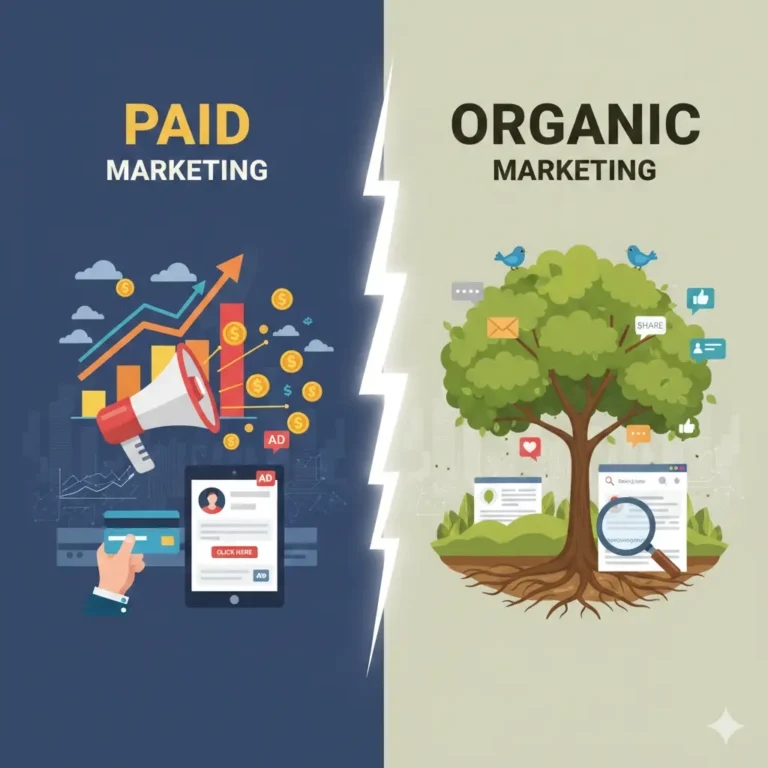
Organic vs. Paid Marketing
Organic Social Media: This refers to the free content that businesses post on their feeds. It is designed to nurture a community and build long-term trust. It relies heavily on social media algorithms to determine who sees the content based on relevance and engagement.
Paid Social Media: This is the commercial side where businesses pay to display ads to a specific target demographic. Through social media advertising, brands can bypass algorithmic limitations and reach thousands of potential customers instantly.
How Social Media Marketing Works
To understand the mechanics of social media marketing for business, we must look at it as a multi-step engine.
1. Platform Selection
Success in social media marketing starts with choosing the right battleground. You don’t need to be everywhere; you need to be where your customers are. For example:
Instagram & Pinterest: Highly visual, perfect for brands like Vanya that focus on elegance and purity.
LinkedIn: The hub for B2B networking and professional content marketing on social media.
YouTube: The king of long-form educational content and tutorials.
2. Content Creation
Content is the “currency” of social media. To succeed, your social media marketing strategy must balance three types of content:
Educational: Solving a problem or teaching a skill.
Entertaining: Using humor, storytelling, or aesthetics to capture attention.
Promotional: Direct calls to action that drive sales. Different formats like Reels, Stories, Carousels, and Live broadcasts ensure that the brand remains fresh and engaging.
3. Audience Targeting
The true magic of social media marketing lies in its precision. Through advanced social media analytics, you can target users based on their specific demographics (age, location), interests (hobbies, liked pages), and online behaviors (recent purchases, frequent travels).
4. Distribution & Promotion
Once the content is ready, it needs to be seen. This involves a mix of scheduled organic posting and strategic paid ads. A brand must understand the “prime time” for their audience to ensure maximum reach and impressions.
5. Measurement & Optimization
Every post provides data. By analyzing the engagement rate and conversion tracking, marketers can perform A/B testing. If a specific video style performs better than a static image, the strategy is adjusted. This cycle of continuous improvement is what leads to high social media ROI.
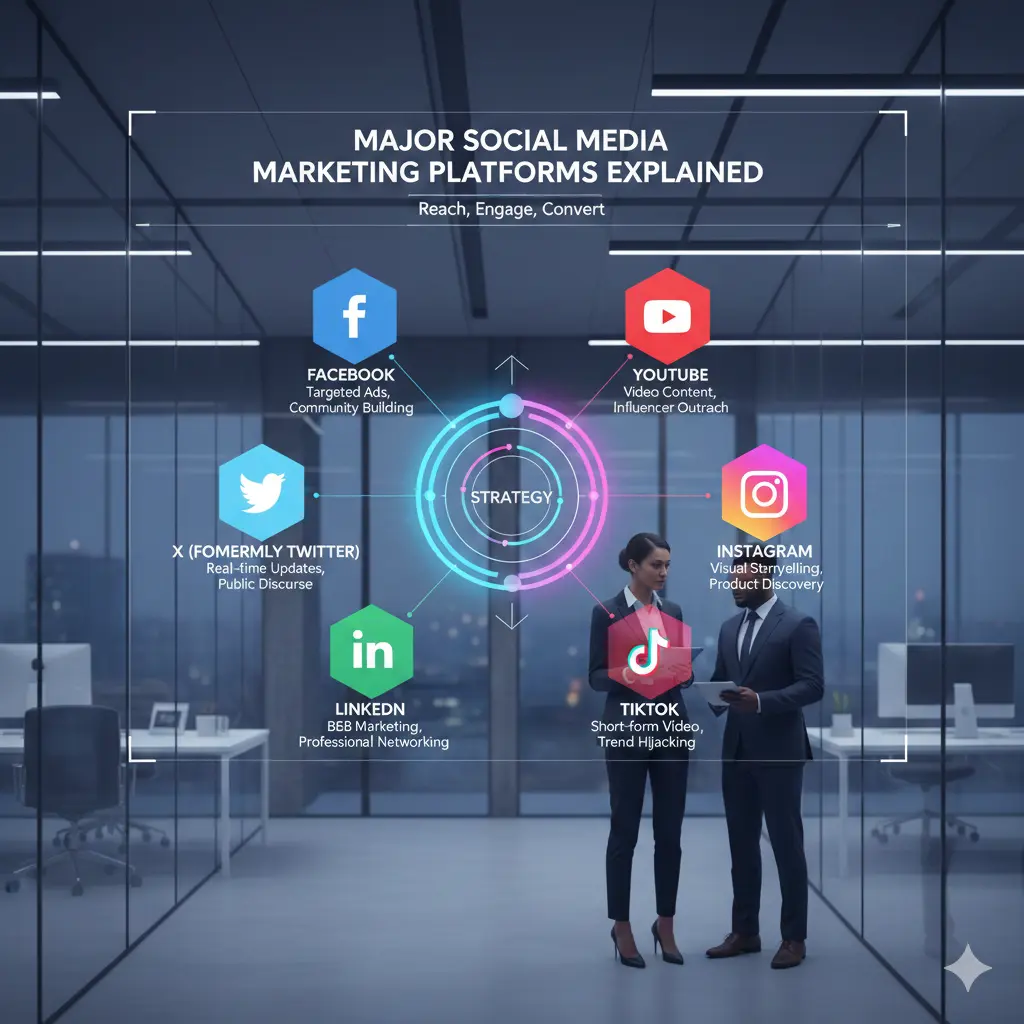
Major Social Media Marketing Platforms Explained
1. Instagram Marketing
Instagram is the home of the “Aesthetic.” It is ideal for brands that can tell a story through visuals. With features like Reels and Shop, it has become a powerhouse for social commerce.
Who should use it: Lifestyle, beauty, fashion, and food brands.
Business Case: Using high-quality imagery to build an aspirational brand image.
2. Facebook Marketing
Despite being one of the oldest platforms, Facebook’s reach is unmatched. Its sophisticated advertising toolset makes it essential for social media marketing for beginners and pros alike.
Who should use it: Local businesses and brands targeting a broad age demographic.
Business Case: Building a dedicated community through Groups and high-conversion ad campaigns.
3. LinkedIn Marketing
LinkedIn is where the “Decision Makers” reside. It is the primary platform for digital brand presence in the B2B world.
Who should use it: Corporate services, SaaS companies, and professional consultants.
Business Case: Establishing thought leadership and generating high-quality B2B leads.
4. YouTube Marketing
As the world’s second-largest search engine, YouTube is about depth. It allows for detailed content marketing on social media through long-form video.
Who should use it: Tech, education, and brands that require detailed explanations.
Business Case: Building long-term authority and “how-to” expertise.
Types of Social Media Marketing
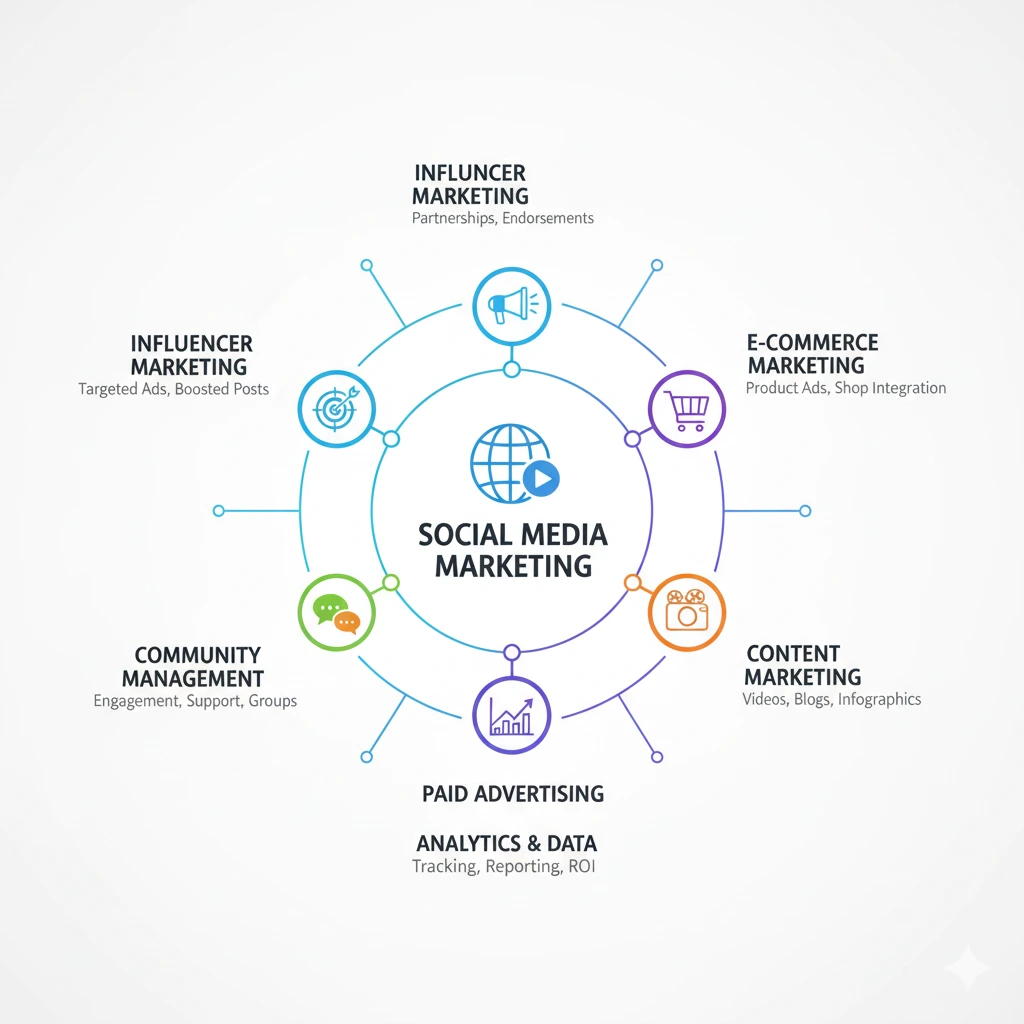
To create a comprehensive social media marketing plan, it is essential to understand the different components, much like the branches of a tree:
1. Organic Social Media Marketing: This method focuses on gradually building a brand’s identity through regular posts, active interaction with the audience, and offering value without requiring payment for visibility.
2. Paid Social Media Advertising: This approach involves targeted efforts to gain market presence rapidly.
It includes methods such as Pay-Per-Click (PPC) campaigns, sponsored content, and “Dark Ads,” which are not shown on a brand’s main feed but reach specific individuals.
3.Influencer Marketing: This strategy involves collaborating with individuals, called “Creators,” who already have a strong connection with the brand’s target audience.
It helps overcome the usual doubts that consumers may have toward traditional brands.
4. Community Management: This involves everyday tasks such as responding to comments, addressing complaints, and handling the brand’s online reputation.
It is where a brand becomes more relatable and personal.
5.Employee Advocacy: When team members share updates about the company, it helps build trust.
People generally trust other people more than they do logos or brand names.
6. Social Commerce: This reduces the steps between discovering a product and making a purchase by enabling direct sales within the app.
It creates a smooth path from first awareness to completing a transaction.
Benefits of Social Media Marketing
Investing in social media marketing brings several advantages that traditional media cannot offer:
1.Unmatched Brand Awareness: Your brand can reach millions of people worldwide.
Unlike a billboard, social media keeps your brand visible to your audience around the clock.
2. Deep Customer Engagement: Real-time feedback and direct communication allow you to develop a loyal following rather than just a list of customers.
3. Efficient Lead Generation: Social media allows for low-cost customer acquisition through precise targeting.
By offering lead magnets, you can attract highly interested potential customers.
4. Direct Website Traffic: Every link in your bio and every swipe on a story can lead to a visitor.
Social media serves as the largest referral system available.
5. Enhanced Customer Support: Publicly responding to customer inquiries builds trust.
It demonstrates that your brand is attentive and cares about its users.
6. Market Insights: By listening to conversations about competitors on social platforms, you can make informed changes to your strategy before market trends shift.
Social Media Marketing Strategy (Step-by-Step)
A successful social media marketing strategy is an ongoing process.
Here is a structured approach known as the Social Crafter framework:
Step 1 – Set Clear Goals
Define your main objective.
Are you focused on audience engagement or conversion tracking? Use the SMART framework (Specific, Measurable, Achievable, Relevant, Time-bound) to set your goals.
Step 2 – Understand Your Audience
Avoid assumptions.
Use data to create a clear “Buyer Persona.” Consider factors like age, location, income level, and the psychological factors that influence purchasing decisions.
Step 3 – Choose the Right Platforms
It is better to be exceptional on one platform than average on many.
Direct your efforts toward platforms where your return on investment is the highest.
Step 4 – Create a Content Plan
Identify your “Content Pillars”—the 3 to 4 main topics your brand will consistently discuss.
This ensures your content remains focused and not haphazard.
Step 5 – Build a Content Calendar
Consistency is key in social media marketing.
A content calendar ensures you maintain a regular schedule and keep your messaging clear across all platforms.
Step 6 – Posting and Engagement
The “Social” in social media marketing is important for a reason.
You must respond to every message or comment. Engagement helps encourage more interaction.
Step 7 – Analytics and Optimization
At the end of each month, review your analytics.
If a post type is not performing well, stop using it. If a type is effective, continue and even expand on it.
Tools Used in Social Media Marketing
Effective social media marketing for businesses requires the right set of tools:
1.Management & Scheduling: Tools like Buffer, Hootsuite, and Later allow you to plan ahead, ensuring your brand stays active even when you’re not.
2.Design & Creativity: Canva and Adobe Express enable non-designers to make professional graphics, while CapCut is widely used for mobile video editing.
3.Analytics & Data: Meta Business Suite and Google Analytics provide in-depth insights into user behavior, helping you understand the reasons behind the data.
4.Research & Listening: Tools like Brand24 and Sprout Social help monitor brand sentiment across the web, letting you stay ahead of potential public relations issues.
Social Media Marketing Examples
1.Local Business (Cafe): Using Instagram Stories to show the “Fresh Brew of the Day,” tagged with a local location to attract morning commuters.
2.E-commerce: Using user generated content where real customers share videos of their unboxing experience to build social proof.
3. B2B (SaaS): A software company running a LinkedIn ad campaign offering a “Free Trial” to CTOs of mid-sized firms.
4. Personal Brand (Consultant): Sharing a “Failure Story” on LinkedIn to show vulnerability and build authentic digital brand presence.
Advanced: The Role of Social Media Algorithms
“To truly master social media marketing, one must understand how the ‘engine’ works. Most social media algorithms prioritize two things: Relevancy and Engagement Speed. By optimizing these factors, you can trigger explosive viral growth and ensure your brand’s message reaches the right audience instantly.”
When you post, the platform shows your content to a small “test group.” If that group likes, comments, or shares quickly, the algorithm expands the reach to a larger group. This is why “Engagement Groups” or “Pods” were popular, though they are now discouraged. Instead, modern social media marketing focuses on “Hooking” the user in the first 3 seconds of a video to ensure high retention rates, which signals to the algorithm that the content is valuable.
Common Mistakes in Social Media Marketing
1. Buying Followers: This destroys your engagement rate and gets you shadowbanned. Fake followers don’t buy products.
2. Ignoring Analytics: Failing to look at the data is like driving a car while blindfolded.
3. Being Too Promotional: If every post says “Buy Now,” people will unfollow. Follow the 80/20 rule: 80% value, 20% promotion.
4. Wrong Platform Focus: Trying to sell corporate law services on TikTok might not be the best use of resources. Understand where your “Decision Makers” hang out.
Social Media Marketing for Small Businesses
Small businesses can beat big corporations on social media because they can be agile and authentic.
1. Niche Down: Don’t try to be for everyone. Be everything to someone.
2. UGC is King: Let your customers do the talking for you. It’s free and more credible.
3. Collaborate: Partner with other local businesses for a mutual online brand pro
By leveraging these high-impact tactics, you create a deeply personal connection that massive, faceless corporations simply cannot replicate. Focus on building a loyal community rather than just a follower count. This authentic engagement transforms your social media presence into a formidable growth engine, proving that strategic agility and genuine human interaction are the ultimate tools for market dominance in 2026.”
Social Media Marketing vs. Traditional Marketing
| Feature | Social Media Marketing | Traditional (TV/Radio) |
| Two-way Communication | Yes | No |
| Targeting | Hyper-Specific | Very Broad |
| Cost | Low/Scalable | High Entry Cost |
| Tracking | Precise & Real-time | Estimated & Delayed |
Future Trends in Social Media Marketing
1.AI Personalization: Content will be customized based on a user’s emotions and previous actions through AI-powered creative tools.
2. Augmented Reality (AR): Retail brands will use “try-on” filters that let users see how products look in their own environment before making a purchase.
3. Community-First Apps: There will be a move away from large social feeds toward smaller, private groups such as those on WhatsApp, Discord, or Telegram, which can lead to better conversion rates.
4. The Creator Economy: Instead of relying on celebrities, brands will focus on micro-influencers who have stronger connections with their followers and are more trusted by their audience.
Conclusion
Social media marketing is the most powerful tool available for growing a business.
It gives small brands the chance to compete with larger companies, allowing a home-based brand to reach global markets. By focusing on delivering value, maintaining consistency, and using data effectively, you can create a brand that endures for years.
At Social Crafter, we help brands build authentic connections through smart, data-driven social media marketing strategies.
Our approach is about driving real business growth, not just increasing likes. Whether you’re launching a new brand or scaling a B2B business, we have the expertise to make your message stand out.
Take the next step:
Book a free strategy call with the Social Crafter team to evaluate your current social media presence.
Download our 2026 Content Calendar template to make planning your posts easier.
Follow us for daily updates on the latest trends in social media marketing.
FAQs Section
It refers to the process of using social platforms to connect with your audience and promote your products or services.
While the platforms themselves are free to use, effective social media marketing often involves an investment of time, professional tools, and a budget for paid advertising.
Brand awareness can show results quickly, but for significant sales and a return on investment, consistent effort over 4 to 6 months is typically needed.
It depends on your audience. LinkedIn is ideal for B2B, while Instagram and TikTok are best for visual B2C products.
Yes, but as your business grows, the need for advanced tools and detailed data analysis usually requires the help of an agency like Social Crafter.
our team is ready to provide tailored answers.
Struggling to grow your brand online? Discover simple, proven strategies that turn your content, design, and marketing into real results.