The Beginner's Guide to Mastering On-Page SEO Techniques for Organic Growth in 2026
Are you trying to improve your website’s visibility on Google without investing heavily in ads?
The answer lies in On-Page SEO. This guide will explain the key On-Page SEO Techniques you need to know in 2026, making it easy for beginners, small business owners, and students to understand and use.
Table of Contents
Toggle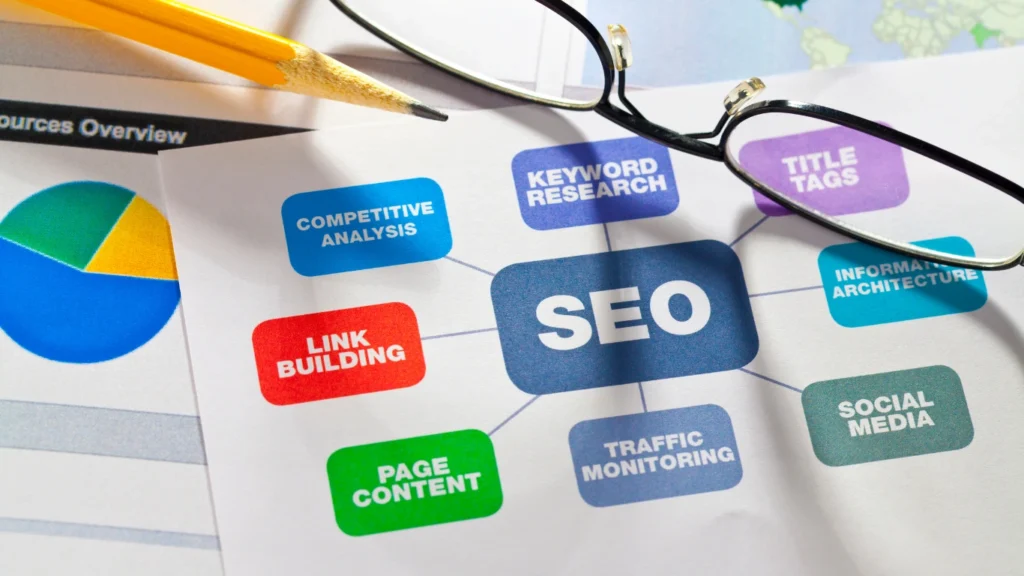
1. What is On-Page SEO?
On-page SEO is the process of optimizing individual web pages to appear higher in search engine results and attract more relevant visitors. It includes improving both the content and the HTML code of a page. These improvements are often called On-Page SEO Techniques, and they help search engines understand what your content is about and how useful it is for users.
By applying the right techniques, you make your page easier to crawl, index, and rank. This includes optimizing title tags, headings, internal links, images, and keyword placement. At the same time, on-page optimization improves user experience by making pages more readable, faster to load, and easier to navigate. When your content is well-structured and valuable, Google is more likely to trust it and show it to the right audience, leading to better visibility, higher engagement, and consistent organic growth over time.
On-page SEO, also known as “on-site SEO,” involves optimizing elements on your website to enhance its search engine ranking and user experience.
It refers to optimizing what search engines can directly see and interact with on your page. The aim is to inform Google that your page provides the best and most valuable answer for a particular search query.
Why on-page SEO is important before off-page SEO:
Imagine your website as a house. On-page SEO is like ensuring the foundation is strong, the rooms are well-organized, and the address is clearly written. This is exactly what On-Page SEO Techniques help you achieve by improving structure, clarity, and relevance. Off-page SEO is like promoting the house to others.
You wouldn’t invite people to a messy, unfinished house, would you? Likewise, you must first optimize your page with proper on-page SEO methods so Google understands what your page is about and sees it as a quality result before seeking external support. A clean, optimized page builds trust, improves user experience, and increases the chances of higher rankings and better engagement.
How on-page SEO helps Google understand your content:
Google uses special programs called “crawlers” or “spiders” to read and understand web pages. By using on-page SEO factors such as clear title tags, proper heading structure, and relevant keywords, you are essentially providing Google with a detailed summary and map of your content. These elements are part of essential On-Page SEO Techniques that help search engines understand the topic, relevance, and quality of your page.
This helps Google correctly categorize your page and match it with relevant user searches. When your content follows proper structure and clarity, it becomes easier for crawlers to index it and for users to navigate it. As a result, your page has a better chance of ranking higher, attracting targeted traffic, and delivering value to the right audience. Consistently applying strong On-Page SEO Techniques builds long-term visibility and trust with search engines.
Related Reading: Want to learn more about the bigger picture?
Check out our full guide: [What Is SEO? A Beginner’s Guide]
Difference between On-Page and Off-Page SEO
| Feature | On-Page SEO | Off-Page SEO |
| Location | Elements on your website (content, code, images) | External signals away from your website (links, social media) |
| Focus | Relevance, quality, user experience (UX) | Authority, trustworthiness |
| Example | Optimizing your title tag | Earning a backlink from a news site |
Real-Life Example (Blog Post)
Imagine you write a blog post titled “10 Must-Try Pulaoo Recipes.”
Some On-Page SEO Techniques you would use include:
Including your main keyword (for example, pulao recipes) in the title and the main heading so search engines clearly understand your topic.
Optimizing the images with descriptive alt text to improve accessibility and image search visibility.
Structuring the content with clear H2 and H3 headings so both users and crawlers can easily scan the page.
Using related LSI keywords like “healthy low-carb meals” and “pulao diet for beginners” to increase topical relevance.
These On-Page SEO Techniques help improve clarity, user experience, and keyword relevance, which increases the chances of your post ranking higher and reaching the right audience organically.
2. Why On-Page SEO Is Important in 2026
Mastering website on-page SEO through effective On-Page SEO Techniques is more critical now than ever before. Here’s why it remains the foundation of any successful SEO strategy for sustainable online growth and visibility.
Helps Google Rank Your Pages: By implementing on-page SEO best practices, you directly influence how Google assesses the topic and quality of your content, leading to higher rankings.
Improves User Experience (UX): Well-optimized pages are faster, easier to read, and simpler to navigate. Google highly prioritizes UX, making it a key seo on page factor.
Increases Organic Traffic: When your pages rank higher for valuable keywords, you capture more of the free, organic traffic from search engines.
Reduces Bounce Rate: Users are less likely to click away immediately (high “bounce rate”) if your page loads quickly and clearly delivers on the promise of the search result.
Supports E-E-A-T Signals: Google’s emphasis on Experience, Expertise, Authoritativeness, and Trustworthiness (E-E-A-T) is partially judged by your on-page elements. High-quality, well-cited, and expertly written content is a strong E-E-A-T signal.
3. Core On-Page SEO Elements (Beginner Must-Know)
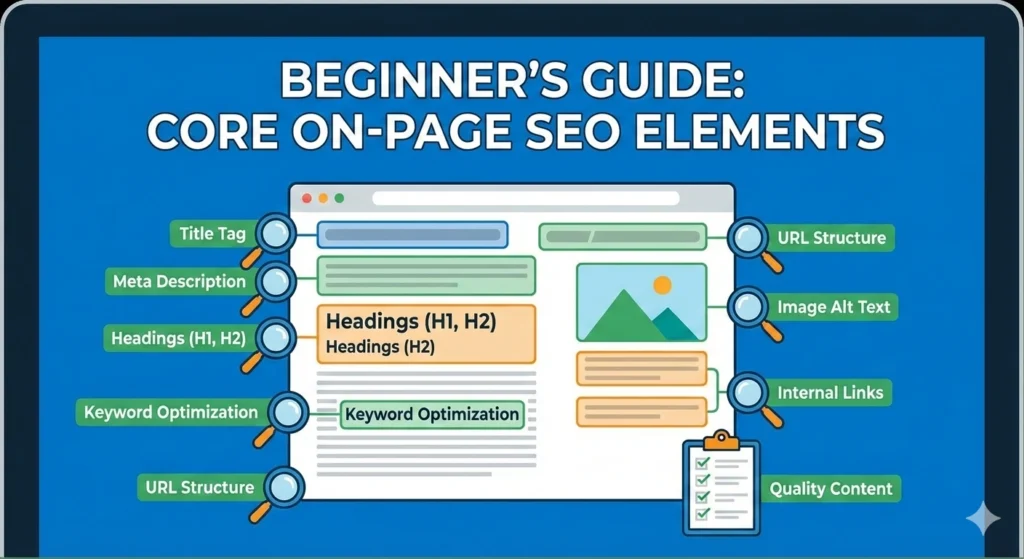
The following On-Page SEO Techniques are the non-negotiable fundamentals every beginner must master to build strong visibility, relevance, trust, and long-term organic growth online.
1. Title Tag Optimization
The Title Tag is the most important on-page SEO factor. It’s the clickable headline that appears on the Google Search Results Page (SERP).
Ideal Length: Keep it between 50–60 characters to prevent it from being cut off by Google (truncated).
Focus Keyword at the Beginning: Place your primary keyword (on page seo techniques) as close to the start as possible.
Power Words Example: Words like Guide, Ultimate, Proven, Quick, Best can increase curiosity and click-through rates.
Example: On-Page SEO Techniques: The Ultimate 2026 Beginner Guide
2. Meta Description Optimization
The Meta Description is the short snippet of text below the title on the SERP. While not a direct ranking factor, it’s crucial for convincing users to click.
Ideal Length: Aim for 150–160 characters.
CTR-Focused Writing: Write it like an advertisement—compelling, benefit-driven, and a clear call-to-action (e.g., “Learn how,” “Read more”).
Keyword Usage Example: Include your main keyword so Google bolds it, increasing visibility.
Example: Master on-page SEO for beginners with our complete 2026 checklist. Learn the proven techniques to boost your rankings and traffic now.
3. URL Structure (SEO-Friendly URLs)
A clean, simple URL helps users and Google understand your page topic immediately.
Short & Readable URLs: Keep them concise and descriptive.
Hyphens Instead of Underscores: Google officially prefers hyphens {-} as word separators.
Keyword Inclusion: Naturally include your target keyword.
Example: $\text{[socialcrafter.com/blog/**on-page-seo-techniques](https://socialcrafter.com/blog/**on-page-seo-techniques)**}$
4. Heading Tags ({H}1–{H}6)
Heading tags provide structure and hierarchy to your content, making it easier to read and scan.
Only one {H}1 per page: This is the main title of your content and should contain your primary focus keyword.
Use Keywords Naturally: Include your primary and LSI keywords in your {H}2and {H}3 headings.
Proper Hierarchy: Use {H}2 for main sections, {H} for sub-sections of the{H}2, and so on.
5. Keyword Placement (Natural Way)
Strategic placement of your main focus keyword (on page seo techniques) and secondary keywords is a fundamental on-page SEO technique.
First 100 Words: Include your main keyword in the first paragraph to immediately confirm relevance to Google.
Headings: Use them in your {H}1 and several {H}2 and {H}3tags.
URL: As mentioned above.
Image Alt Text: Describing your images (see Section 6).
Conclusion: A final mention to summarize the topic.
Avoid Keyword Stuffing: A density of 30 mentions of “on page seo techniques” should be evenly distributed and only used when it sounds natural in the text. Using keywords awkwardly or excessively >3 density) will harm your rankings. Focus on LSI/Semantic Keywords (what is on-page seo, on-page seo factors list) to naturally increase relevance.
4. Content Optimization Techniques
Google’s mission is to deliver the best answer to a user’s query. This means high-quality, readable, and comprehensive content is the king of on-page SEO optimization.
Write for Humans, Not Bots: Your primary audience is the user. Focus on clarity, value, and answering the user’s need (search intent).
Use Short Paragraphs: Break up large blocks of text. Aim for {2–4} sentence paragraphs to improve scannability, especially on mobile devices.
Bullet Points and Numbered Lists: These break the text visually, highlight key takeaways, and are excellent for answering “how-to” or “listicle” search intents.
Simple Language: Avoid overly complex jargon (unless your audience is highly technical). Keep the reading level accessible.
Answer Search Intent: Understand why the user is searching. Are they looking for an answer (Informational), a product (Commercial), or a location (Navigational)? Ensure your content matches the intent.
Add FAQs: A dedicated Frequently Asked Questions section at the end is a powerful on-page SEO technique for addressing related, long-tail queries and potentially earning a Google “People Also Ask” box.
Deep Dive: Ready to refine your content skills? Check out our guide: [How to Write SEO-Friendly Content]
5. Image Optimization for On-Page SEO
Images improve user experience, but if not optimized, they can drastically slow down your page speed.
Image Compression: Use tools (like TinyPNG or ShortPixel) to reduce the file size ($\text{KB}$) without losing noticeable quality.
Proper File Names: Use descriptive, keyword-rich file names before uploading.
Bad: {IMG00123.jpg}
Good: {on-page-seo-checklist.jpg}
Alt Text Usage: Alternative text (Alt Text) describes the image for visually impaired users and for Google’s crawlers, who cannot “see” images.
Example Alt Text: on page seo techniques for beginners checklist summary with 9 steps
Lazy Loading: This feature ensures images only load when a user scrolls down to see them, significantly improving the initial page load speed.
6. Internal Linking
Internal linking is the practice of hyperlinking one page on your website to another. This is a vital on page seo factor.
Link Related Blogs: Point users to other valuable, contextually related articles on your site.
Improves Crawlability: Internal links guide Google’s crawlers from one page to the next, helping them discover all your content.
Passes Link Juice: Internal links help distribute authority (or “link juice”) across your site, boosting the ranking potential of other pages.
Keeps Users Longer on Website: By offering a path to deeper, related information, users spend more time on your site, signaling high engagement to Google.
Rule: Aim for t{2–4} relevant internal links per blog post.
7. Schema Markup & Rich Results
What is Schema Markup?
Schema Markup is code (microdata) you add to your website to help search engines better understand your content. It’s a way of labeling and categorizing the information on your page.
FAQ Schema: One of the most popular and easiest to implement for beginners, it allows your FAQs to appear as clickable drop-downs directly under your result on the SERP.
How it Improves CTR: Schema generates “Rich Results” (or Rich Snippets) that take up more space and stand out on the SERP, dramatically increasing your Click-Through Rate (CTR).
Tools (Mention Only): Tools like the Google Structured Data Markup Helper or various SEO/Schema plugins can help you implement this code without needing to write it from scratch.
8. Common On-Page SEO Mistakes Beginners Make
Avoid these pitfalls to ensure your on-page SEO techniques are effective:
Keyword Stuffing: Overusing your keywords to the point where the text is unnatural.
Duplicate Content: Having identical or near-identical content on multiple pages. Use canonical tags to resolve this.
Missing Meta Tags: Forgetting to write unique, compelling title tags and meta descriptions for every page.
Thin Content: Publishing pages with minimal value or word count that don’t satisfy the user’s intent.
No Internal Linking: Isolating pages without connecting them to the rest of your site’s structure.
9. On-Page SEO Checklist
Use this on page seo checklist for every page you publish:
Title Tag: {<60} characters, focus keyword at the start.
Meta Description: {<160} characters, compelling, included keyword.
URL: Short, hyphenated, and readable with the keyword.
{H}1–{H}3: Proper hierarchy, one {H}1 with the focus keyword.
Keyword Placement: Used naturally in the first {100}words and distributed throughout (density approx {2).
Images: Compressed, proper file names, and descriptive Alt Text.
Internal Links: {2–4} relevant links to other pages on your site.
Mobile-Friendly: Passed Google’s Mobile-Friendly Test.
Page Speed: Checks Core Web Vitals (fast loading).
10. FAQs
On-Page SEO Techniques are the methods used to optimize your website’s content and structure so search engines can understand it better. These techniques are important because they improve visibility, increase organic traffic, and help your pages rank for relevant searches while offering a better user experience.
On-Page SEO Techniques help Google clearly identify your page topic, relevance, and quality. When your titles, headings, content, and internal links are optimized correctly, Google can index your page more accurately and match it with the right search queries.
Yes, beginners can easily apply On-Page SEO Techniques by focusing on content quality, keyword usage, clear headings, readable structure, and basic optimizations like meta tags and image alt text without needing advanced coding skills.
On-Page SEO Techniques should be reviewed regularly, especially when content becomes outdated or rankings drop. Updating content, improving structure, and refining keywords helps maintain relevance and performance over time.
Yes, On-Page SEO Techniques improve user experience by making content easier to read, pages faster to load, and navigation more intuitive, which increases engagement and reduces bounce rates.
On-Page SEO Techniques are the foundation of ranking, but they work best when combined with off-page SEO and technical SEO. Strong on-page optimization ensures your content is ready to rank when external signals support it.
The biggest mistake with On-Page SEO Techniques is keyword stuffing or focusing only on search engines instead of users. Effective optimization balances relevance, clarity, and user value for sustainable results.
11. Conclusion
Mastering these on-page SEO techniques is not a one-time task—it’s an ongoing process of refinement and quality assurance. Consistent optimization ensures your website remains competitive, highly relevant, and delivers the best possible experience to the user. By following this guide, you have laid the groundwork for significant and sustainable organic growth.
for more information also read articles from search engine journals
Search behavior, algorithms, and user expectations constantly evolve, which means your website must evolve with them. Regularly reviewing your content, improving structure, updating information, and refining internal links helps maintain relevance and authority. This ongoing effort ensures your site continues to meet both user needs and search engine standards.
At SocialCrafter, we follow proven on-page SEO techniques that help businesses build strong search visibility and long-term organic growth. Our approach focuses on clarity, quality, and performance so your website not only ranks well but also converts visitors into customers. With the right strategy and consistent execution, on-page SEO techniques become a powerful asset for building trust, authority, and lasting online success. When applied correctly, these on-page SEO techniques support stable rankings, improved engagement, and reliable organic traffic over time.
our team is ready to provide tailored answers.
Struggling to grow your brand online? Discover simple, proven strategies that turn your content, design, and marketing into real results.